
HeyParty - Chat room & Live
Mevla TeamSocial
4.161.00 Reviews
- Version
- 1.0.36
- Installs
- 100.00K
- Age Rating
- Mature 17+
Screenshots
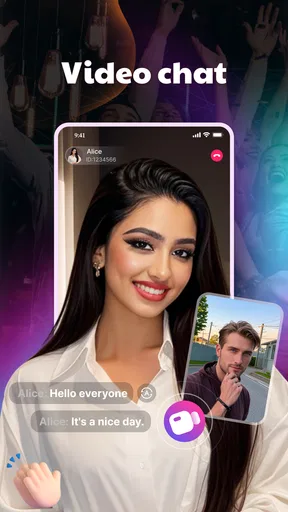
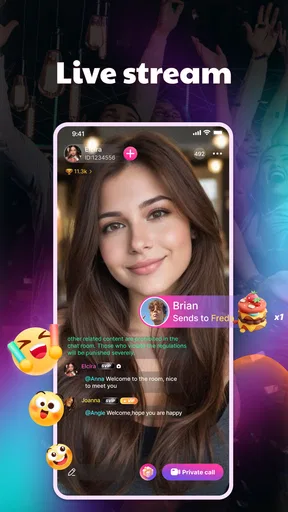
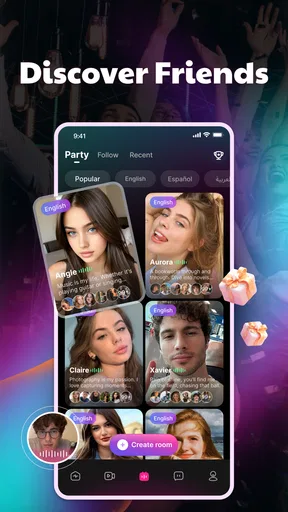
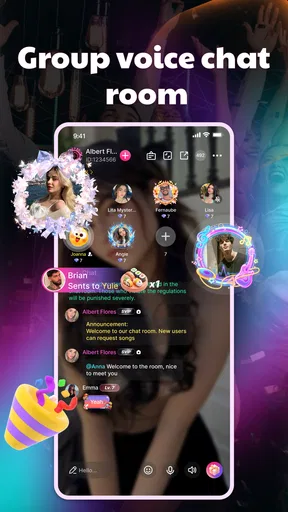
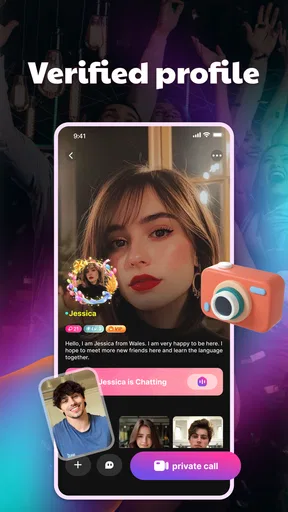
Our Review of HeyParty - Chat room & Live
 Analysis by Appyee
I opened HeyParty with a simple question in mind: what is it actually like when the goal is to meet people through live video rather than send messages back and forth? The app sits in the social category and focuses on online video chat with strangers, so its appeal is immediate conversation, not a carefully built profile or a slow-growing contact list. My first impression was that it is designed for people who want interaction to begin quickly, even if that also means accepting more unpredictability than I would get from a conventional messaging app.
That starting point matters. HeyParty is not the app I would choose when I want to speak only with people I already know, and it is not a replacement for a private group messenger. It is better understood as a spontaneous social doorway: you enter with time to spare, accept that the other person may be very different from you, and decide whether the conversation deserves another minute. The developer is Mevla Team, and the app is free to install, with optional in-app purchases ranging from $2.99 to $99.99 per item.
From opening the app to finding a conversation
The most realistic way to use HeyParty is to begin with a small, flexible goal. I would not open it expecting a guaranteed meaningful friendship every time. I would open it after work, while waiting for an appointment, or when I wanted a quick break from the same familiar feeds. That mindset makes the experience easier because a short or awkward exchange is not automatically a failure; it is part of the format.
The app’s store short description is “HeyParty,” while its fuller purpose is much clearer in practice: it puts live video interaction at the center. Instead of composing a polished introduction, I have to be ready to respond in the moment. That changes the social skill involved. A clear voice, a friendly opening question, and the ability to end an uncomfortable exchange politely matter more here than a clever written bio.
For a first session, I would keep the objective narrow: test how quickly I can reach a conversation, notice how comfortable I feel on camera, and learn how the app handles a mismatch. This is one of the useful ways to approach a stranger-chat service. I am not handing over an entire evening to it. I am running a short experiment, and I can leave when the experiment stops being enjoyable.
HeyParty is rated for mature users aged 17 and older. That is an important part of the starting condition, not a footnote. Anyone considering it should treat a live video chat with strangers as an environment requiring judgment. I would avoid sharing a full name, school or workplace details, home location, personal contact information, or anything visible in the background that identifies where I live. A plain background and a nickname are sensible choices for this kind of app.
What the live format changes
Video creates a faster sense of presence than text, but it also removes some protective distance. In a messaging app, I can pause, edit, or ignore a message. In a live exchange, I have to make decisions while the conversation is happening. That can feel exciting when both people are relaxed, yet tiring when the other person dominates the interaction or behaves in a way I do not like.
My practical advice is to prepare two or three neutral opening topics before starting. Travel, music, food, films, hobbies, and the reason someone is using a social app are safer starting points than questions about money, relationships, or personal identity. This small preparation reduces the blank-screen feeling and helps me judge the quality of the interaction instead of spending the first moments wondering what to say.
Another useful habit is to set a time boundary. A live stranger-chat app can encourage one more conversation, then another, without producing a satisfying result. I would decide in advance whether I have ten minutes or an hour. If the experience is good, I can continue; if it is repetitive, I can close it without feeling that I have wasted the whole evening.
A practical session, step by step
My workflow would look like this. First, I choose a quiet place and check what the camera will show. Second, I enter with a simple introduction rather than trying to perform. Third, I watch for basic conversational signals: does the other person listen, answer normally, and respect a change of subject? Fourth, I decide quickly whether to continue. Finally, I leave the conversation if it becomes uncomfortable, confusing, or simply uninteresting.
This approach gives HeyParty a clearer purpose. I am not trying to collect as many exchanges as possible. I am filtering for conversations that feel mutual. That is a non-obvious trade-off of the format: speed increases the number of chances to meet someone, but it also increases the number of interactions I will discard. The app works best when I accept that filtering is part of the experience rather than expecting every connection to become important.
A realistic everyday scenario would be a student or remote worker taking a break after spending several hours alone. They open HeyParty hoping for a little conversation, meet someone with a different routine, and spend a few minutes comparing hobbies. The result may simply be a pleasant interruption to the day. That is still a valid outcome. The app does not need to produce a lasting friendship to be useful in that moment.
Managing the handoff from one person to the next
The handoff between conversations is where this type of app differs most from ordinary social networks. In a familiar network, I usually choose who to contact from a profile, mutual connection, or known group. With HeyParty, the next interaction can feel more like opening a new door. That makes transitions quick, but it also means I need a personal method for deciding when to stay and when to move on.
I would use a simple three-part check: comfort, reciprocity, and relevance. Comfort means I do not feel pressured or exposed. Reciprocity means both people get a chance to speak. Relevance means the conversation has at least one subject we can explore. If two of those three disappear, I would end the exchange instead of trying to rescue it.
Ending a chat does not need to become dramatic. A brief “I’m going to stop here, take care” is enough. If the other person reacts badly to a normal goodbye, that is useful information in itself. I would not argue, explain my private reasons, or reveal more details to soften the exit. The ability to leave cleanly is one of the most important skills for using HeyParty comfortably.
There is also a handoff from the app to my wider digital life. A stranger may ask to move the conversation elsewhere. I would treat that as a separate decision, not as the automatic next step. Keeping the interaction inside the app for longer gives me more control. If I eventually choose to continue elsewhere, I would use an account that does not expose my main identity and would avoid sending photos or information that I would not want a stranger to retain.
This is where HeyParty can be more demanding than a standard social feed. A feed lets me consume content passively. Live video asks me to manage boundaries in real time. Users who want low-effort browsing may find that tiring. Users who enjoy quick conversation and are comfortable making firm choices may find the same quality energizing.
What I would expect from the free version
HeyParty is free, which lowers the barrier to trying it. Still, the presence of optional purchases means I would not assume that every part of the experience is equally unrestricted. The listed purchase range runs from $2.99 to $99.99 per item, so I would inspect any purchase prompt carefully before confirming it and keep spending separate from the question of whether I actually enjoy the conversations.
My rule would be simple: use the free experience long enough to understand the basic rhythm before paying for anything. A purchase cannot solve a poor social match, awkward communication, or a lack of interest in live video. If the core interaction does not feel worthwhile without spending, I would not expect an upgrade to transform it into a different kind of app.
This is also a good place to distinguish HeyParty from subscription-focused dating services. Dating apps usually encourage profile comparison, written preferences, and deliberate matching. HeyParty’s live stranger-chat approach is more immediate and less structured. That can be refreshing for casual social contact, but it offers less preparation and may provide less context before the conversation begins. Someone searching for a carefully filtered romantic match would probably be better served by a dedicated dating platform.
How it compares with familiar social alternatives
Compared with text-first messengers, HeyParty offers faster emotional feedback but less control over pacing. Compared with large social networks, it can feel more direct because the interaction is the main event rather than a comment beneath a post. Compared with random video-chat services, its value depends heavily on how comfortable I am with the particular flow and the people I encounter, rather than on a long-term community I already understand.
That comparison reveals who is most likely to enjoy it. I would recommend trying HeyParty to an adult who likes meeting unfamiliar people, can handle short conversations without taking them personally, and is willing to protect private information. It may also suit someone practicing casual conversation in a low-stakes setting, provided they remember that another stranger is not automatically a safe language partner or a trustworthy contact.
I would steer away from it if I dislike being on camera, need predictable and moderated communication, or feel pressured to keep talking once a conversation has started. It is also a poor choice for anyone looking for a private family or work channel. A normal messenger, a moderated interest group, or a profile-based service will be a better fit in those situations because each gives more control over who enters the conversation and why.
Where the workflow can break
The first break point is expectation. If I enter expecting every stranger to be interesting, the app will disappoint me quickly. Live social discovery naturally includes mismatches, silence, and conversations that end without a clear reason. The useful result is not a perfect stream of connections; it is the occasional interaction that feels natural enough to remember.
The second break point is personal safety. Video can reveal more than I intend, including my surroundings, routine, or appearance. I would check the frame before starting, remove identifying items from view, and avoid discussing where I will be later. If someone asks for private details early, pushes me to another service, or makes me uncomfortable, I would end the interaction rather than negotiate.
The third break point is emotional energy. Even a friendly conversation can be draining when I am already tired. Because HeyParty is built around live exchanges, I cannot always consume it passively. I would use it when I have enough attention to listen and respond, not when I am trying to fill silence while doing something else.
The fourth break point is spending. Free access makes experimentation easy, but optional purchases can turn curiosity into an unplanned expense. I would read each confirmation screen, avoid buying merely to continue a disappointing session, and judge the app on the quality of the basic experience first. That is especially important because the available purchase range reaches from a small trial-sized amount to a much larger one.
Finally, there is the question of device compatibility. The current version is 1.0.36 and requires Android 6.0 or newer. For someone using an older Android phone, checking the operating-system requirement before planning a session is worthwhile. A live video app also benefits from a stable connection and a quiet setting, even though those conditions depend on the user rather than the app itself.
My result after weighing the whole experience
HeyParty has a clear identity: it is for spontaneous video conversation with strangers, not for maintaining an existing circle or carefully researching people before contact. Its strongest quality is immediacy. I can approach it with a small amount of time and a willingness to talk, then decide conversation by conversation whether it deserves my attention.
Its weakness is the same immediacy. The app asks me to handle uncertainty, boundaries, and awkward exits without the structure offered by profile-based services or private messaging tools. That does not make it bad, but it does make user judgment central to the experience. The app is only as comfortable as the limits I set while using it.
Mevla Team’s app has reached over 100 thousand installs and holds a 4.1 average from around 492 ratings, with 61 written reviews. Those figures suggest that it has found an audience, but I would still treat the numbers as a reason to investigate rather than a guarantee that it will suit me. Live social apps are unusually personal: the same session can feel lively to one person and exhausting to another.
My recommendation is therefore specific. Try it if you want quick, unscripted social contact and are comfortable leaving conversations that do not feel right. Start with a short session, protect your background and identity, avoid rushing to external contact, and delay purchases until you understand the free experience. Skip it if you need predictable matches, private communication, or a highly controlled social environment.
For me, the best outcome HeyParty can deliver is not a constant stream of new friends. It is a brief, genuine exchange that breaks up an ordinary day without asking me to surrender control. Use it as a doorway to conversation, not as a substitute for trust. With that expectation, the app can be an interesting social experiment; without it, the speed and uncertainty may outweigh the fun.
Verdict
Strengths of HeyParty - Chat room & Live
- Easy way to join live chat rooms based on shared interests.
- Interactive voice features make conversations feel more immediate.
- Room discovery helps users find active discussions quickly.
- Social tools encourage meeting new people from different backgrounds.
- Frequent live activity can make the app feel lively and engaging.
Limitations of HeyParty - Chat room & Live
- Public rooms may include strangers whose behavior is unpredictable.
- Busy rooms can be noisy and difficult to follow.
- Some features may require virtual currency or additional purchases.
- The quality of conversations depends heavily on the room hosts.
- Using live audio and video features may consume significant battery and data.
Similar Picks in This Category
View All
Meta Platforms, Inc.4.6

Instagram4.0

Likee-Live, Chat & Party Games
Likeme Pte. Ltd.4.4

Facebook Lite
Meta Platforms, Inc.4.5

TikTok - Videos, Shop & LIVE
TikTok Pte. Ltd.4.0

Moj: Free Short Drama & Reels
ShareChat4.1
Frequently Asked Questions
What is HeyParty - Chat room & Live, and what can I do with it?
HeyParty - Chat room & Live is a social entertainment app focused on live interaction through chat rooms, voice conversations, and community-based activities. After creating a profile, users can explore public rooms, join ongoing discussions, meet people with similar interests, and participate in live sessions. The experience is designed for casual conversation and social discovery rather than private messaging alone.
Is HeyParty - Chat room & Live free to download and use?
The app can generally be downloaded for free, allowing users to create an account, browse rooms, and access some basic social features without an upfront purchase. However, certain functions may depend on virtual items, premium services, subscriptions, or in-app purchases. Availability and pricing can vary by country and platform, so it is worth checking the store listing and payment details before buying anything.
Do I need to create an account to use HeyParty?
Most of HeyParty’s interactive features require an account because profiles, room participation, conversations, and social connections need to be linked to a user identity. Registration may involve basic personal information and, depending on the current version, a phone number, email address, or supported social login. Review the permissions and privacy settings carefully, and avoid sharing sensitive information publicly.
Is HeyParty - Chat room & Live safe for younger users?
Because HeyParty centers on live chat and user-generated conversations, the content and behavior in rooms can vary considerably. Parents and guardians should review the app’s age rating, community guidelines, reporting tools, and privacy controls before allowing a child to use it. Users should never share passwords, exact locations, financial details, or private contact information with strangers, and inappropriate behavior should be reported.
What should I check before downloading HeyParty on Android or iOS?
Before installing HeyParty, check whether your device meets the current operating-system requirements and whether you have enough storage and a stable internet connection. Live rooms may use noticeable mobile data and battery power, especially during extended sessions. Also review the app’s permissions, privacy policy, subscription terms, and recent user feedback so you understand how your information and purchases may be handled.
